Short answer: Standing outside your own front door in triple-digit heat makes people do costly things — pry, kick, or jam a card into a deadbolt that will never move. Before you turn a free lockout into a door-repair bill, it's worth slowing down and working through the calmer options first.
Standing outside your own front door in triple-digit heat makes people do costly things — pry, kick, or jam a card into a deadbolt that will never move. Before you turn a free lockout into a door-repair bill, it's worth slowing down and working through the calmer options first.
Start with a full loop of the house for an unlocked window, back slider, or garage service door, then check any hide-a-key spot and the garage keypad. Ask whether a partner, roommate, landlord, or property manager holds a spare before you assume there's no key within reach. And genuinely, step into shade and drink water while you think — heat exhaustion clouds judgment and rushes bad decisions. One thing that does not work: the credit-card trick only slips a spring latch (the angled bolt on a knob), never a deadbolt, and it usually just snaps the card and scratches the door edge.
Forcing entry almost always costs more than the lockout itself. Kicking splits the jamb where the strike sits, prying bends the door slab and breaks the weatherstrip seal — which matters a lot in Phoenix, where a gapped door leaks cooled air and drives up your AC bill all summer. Drilling ruins the cylinder you'd otherwise keep. A locksmith's non-destructive entry is designed to leave the lock working afterward, so you're not also buying new hardware. As a rough sense of scale, a standard residential lockout is typically a modest service fee, while a cracked frame or bent door becomes a carpentry job on top of a new lock.
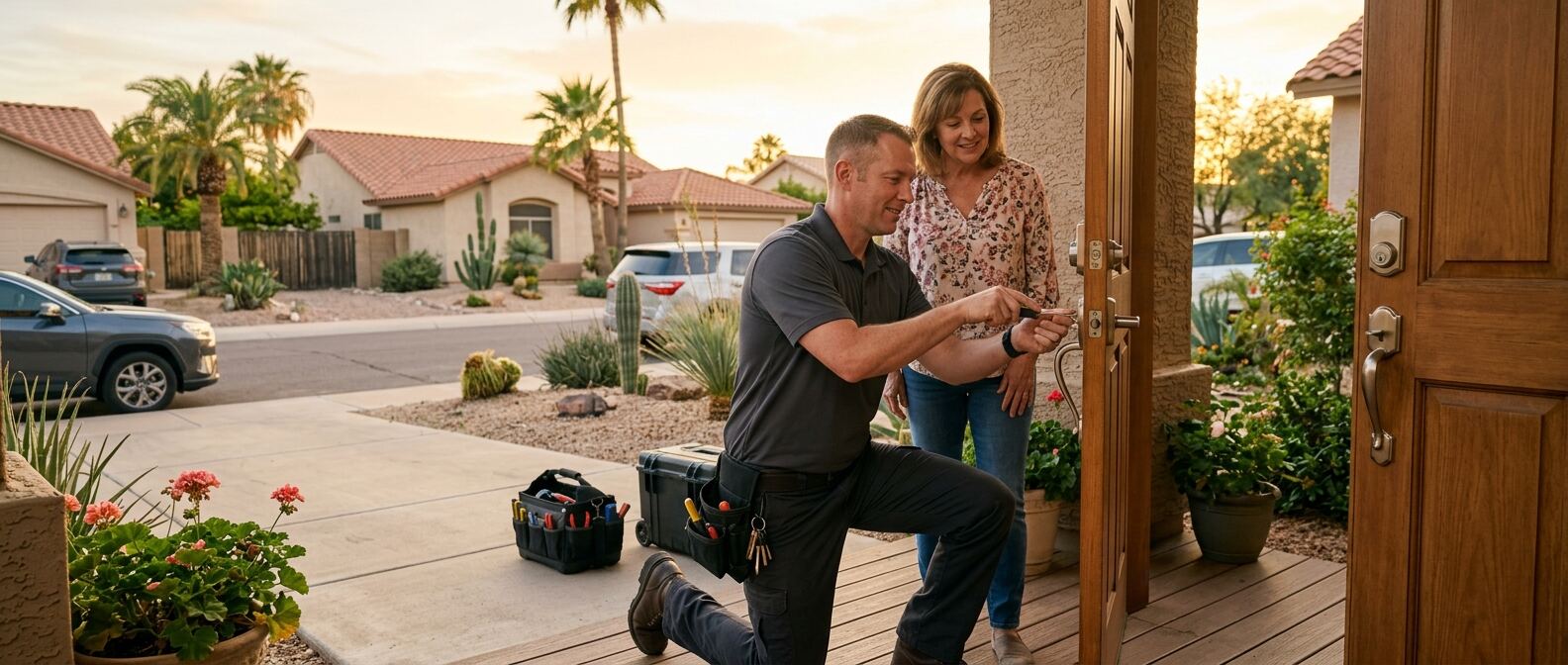
Most everyday residential deadbolts and knobs are quick, non-destructive work for a locksmith. High-security or smart locks can take longer and sometimes need extra verification, and car lockouts are a different skill set entirely. Expect to be asked for ID and some proof you live at the address — a reputable locksmith requires it, and that's a reassuring sign, not a hassle. Having your ID and a piece of mail or a lease handy speeds the whole thing up, so you're back inside and back in the air conditioning faster.
Start with a full loop of the house for an unlocked window, back slider, or garage service door, then check any hide-a-key spot and the garage keypad. Ask whether a partner, roommate, landlord, or property manager holds a spare before you assume there's no key within reach. And genuinely, step into shade and drink water while you think — heat exhaustion clouds judgment and rushes bad decisions. One thing that does not work: the credit-card trick only slips a spring latch (the angled bolt on a knob), never a deadbolt, and it usually just snaps the card and scratches the door edge.
Forcing entry almost always costs more than the lockout itself. Kicking splits the jamb where the strike sits, prying bends the door slab and breaks the weatherstrip seal — which matters a lot in Phoenix, where a gapped door leaks cooled air and drives up your AC bill all summer. Drilling ruins the cylinder you'd otherwise keep. A locksmith's non-destructive entry is designed to leave the lock working afterward, so you're not also buying new hardware. As a rough sense of scale, a standard residential lockout is typically a modest service fee, while a cracked frame or bent door becomes a carpentry job on top of a new lock.
Most everyday residential deadbolts and knobs are quick, non-destructive work for a locksmith. High-security or smart locks can take longer and sometimes need extra verification, and car lockouts are a different skill set entirely. Expect to be asked for ID and some proof you live at the address — a reputable locksmith requires it, and that's a reassuring sign, not a hassle. Having your ID and a piece of mail or a lease handy speeds the whole thing up, so you're back inside and back in the air conditioning faster.
Call (928) 436-8222 and describe the situation, your exact location, and what you need. Timing is confirmed on that call rather than promised in advance.
Call for help: (928) 436-8222 — a straight answer and an honest estimate before any work begins.