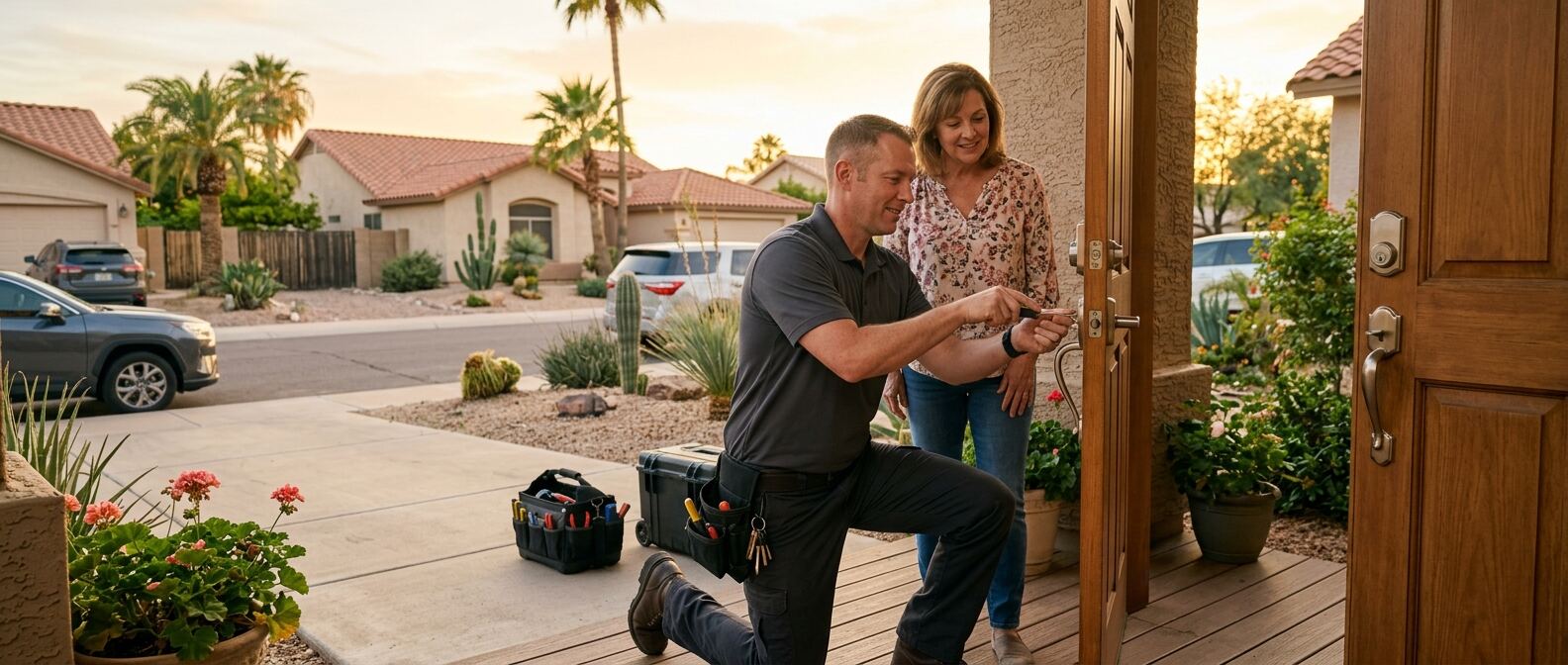
Short answer: Not every lock problem needs a professional, and not every online tutorial is being honest about the risk. This is a straight breakdown of what a confident homeowner can handle with a screwdriver and some patience, and where a five-minute shortcut turns into a bigger repair bill.
Not every lock problem needs a professional, and not every online tutorial is being honest about the risk. This is a straight breakdown of what a confident homeowner can handle with a screwdriver and some patience, and where a five-minute shortcut turns into a bigger repair bill.
Plenty of lock work is genuinely DIY-friendly when the hardware is standardized and undamaged. Swapping a deadbolt or knob for a like-for-like replacement that uses the same door prep is usually a screwdriver job — just measure your backset (the 2-3/8" or 2-3/4" distance from the door edge to the center of the bore) and confirm the standard 2-1/8" bore hole before you buy. Tightening loose set screws, replacing worn weatherstripping, and freeing a sticky cylinder with a dry graphite or PTFE lubricant (never WD-40, which gums up over time) are all reasonable. If you're comfortable and your locks are a common pin-tumbler brand, a matching-brand rekey kit can even let you re-pin same-key cylinders yourself.
Some tasks are deceptively simple in a video and expensive in real life. Programming a modern car key or transponder generally needs dealer-level or locksmith equipment tied to the vehicle, so a cheap online blank rarely works alone. Drilling a lock, cutting a key by eye, or forcing a door during a lockout tends to destroy hardware you could have saved. Safe lockouts are their own specialty and a wrong move can trigger relockers. And installing a high-security or smart lock on a door that isn't hanging square will fight you forever, because no lock corrects a frame problem.
Before starting, ask yourself three things. First, is the hardware standard and undamaged, or are you improvising around something bent, drilled, or off-brand? Second, is the step reversible — can you stop and put it back if it goes sideways? Third, if it fails, does it lock you out of a door you actually need tonight? A 'no' on any of those is your signal to call. One Phoenix-specific note: summer heat expands doors and shifts frames, so a bolt that suddenly binds is often a door-alignment issue, not a broken lock — swapping the lock won't fix it, and a pro can tell the difference in minutes.
Plenty of lock work is genuinely DIY-friendly when the hardware is standardized and undamaged. Swapping a deadbolt or knob for a like-for-like replacement that uses the same door prep is usually a screwdriver job — just measure your backset (the 2-3/8" or 2-3/4" distance from the door edge to the center of the bore) and confirm the standard 2-1/8" bore hole before you buy. Tightening loose set screws, replacing worn weatherstripping, and freeing a sticky cylinder with a dry graphite or PTFE lubricant (never WD-40, which gums up over time) are all reasonable. If you're comfortable and your locks are a common pin-tumbler brand, a matching-brand rekey kit can even let you re-pin same-key cylinders yourself.
Some tasks are deceptively simple in a video and expensive in real life. Programming a modern car key or transponder generally needs dealer-level or locksmith equipment tied to the vehicle, so a cheap online blank rarely works alone. Drilling a lock, cutting a key by eye, or forcing a door during a lockout tends to destroy hardware you could have saved. Safe lockouts are their own specialty and a wrong move can trigger relockers. And installing a high-security or smart lock on a door that isn't hanging square will fight you forever, because no lock corrects a frame problem.
Before starting, ask yourself three things. First, is the hardware standard and undamaged, or are you improvising around something bent, drilled, or off-brand? Second, is the step reversible — can you stop and put it back if it goes sideways? Third, if it fails, does it lock you out of a door you actually need tonight? A 'no' on any of those is your signal to call. One Phoenix-specific note: summer heat expands doors and shifts frames, so a bolt that suddenly binds is often a door-alignment issue, not a broken lock — swapping the lock won't fix it, and a pro can tell the difference in minutes.
Call (928) 436-8222 and describe the situation, your exact location, and what you need. Timing is confirmed on that call rather than promised in advance.
Call for help: (928) 436-8222 — a straight answer and an honest estimate before any work begins.